
Get Your Owned Channels ready for Conversational Commerce
As AI platforms become the primary gateway to the internet, enterprises face a major structural shift: digital storefronts must now cater to both humans and autonomous AI agents who are quickly becoming the how-to for individual assistance.


To capture market share, brands must move past static screens and optimize their owned channels from web shops to in-store kiosks for real-time, natural language discovery and machine-readable data.
The Shift to Dynamic Experiences
For decades, ecommerce relied on visual and emotional triggers: high-resolution imagery, persuasive copywriting, and frictionless UX layout. On your owned channels, these assets are no longer enough. When AI agents or conversational interfaces query your catalog, they ignore the visual design. They reward cleanly structured, hyper-accurate, and instantly verifiable data. If your product information cannot support an LLM-driven system within milliseconds, your brand becomes functionally irrelevant.
To win in this new landscape, businesses must distribute their commerce infrastructure across a new breed of touchpoints, transforming enterprise chatbots, agent selling platforms, and in-store digital terminals into intelligent conversational hubs.
Use Cases That Redefine Brand Interaction
Optimizing your owned channels for the conversational and agentic web unlocks high-value use cases across the entire customer lifecycle. Here is how these scenarios translate into business value:
1. Conversational Commerce & Guided Selling
Traditional filters (size, color, price) fail when handling complex, multi-variable purchasing decisions. Conversational commerce transforms the discovery phase into a dynamic dialogue.
The Execution: A customer looking to configure a custom enterprise server network or a personalized, ingredient-sensitive skincare routine can state their high-level goals in natural language.
The AI Value: The system cross-references deep product attributes, technical compatibility rules, and user constraints on the fly, acting as an elite, always-available sales consultant that guides the user to the perfect SKU.
2. In-Store Terminal Commerce & Conversational Kiosks
Physical retail environments are often disconnected from the wealth of digital data available online. Smart terminals and conversational kiosks bridge this gap. Let your brand communicate with your customers in real-time.
- The Execution: Customers shopping in-store can talk to an intelligent kiosk to query omni-channel inventory, compare products across locations, or view digital-only variants.
- The AI Value: By bringing natural language search to the showroom floor, retailers eliminate the friction of out-of-stock items, allowing customers to instantly order variations to their doorstep via a simple voice command.
3. Commerce & Entertainment to Go (Connected Mobility)
The vehicle and the smart home are evolving into highly contextual commerce environments where screens are secondary or non-existent.
- The Execution: While commuting, a driver can use voice interaction embedded in their connected mobility system to manage daily commerce tasks.
- The AI Value: Based on location data, schedule, and historical preferences, the system allows users to seamlessly reorder everyday goods, book location-based services (like reserving a charging station), or renew digital subscriptions on the move, safely and hands-free.
4. Agentic Checkout Enablement
The checkout funnel is traditionally designed for human eyes and clicks. Agentic enablement re-engineers this infrastructure for programmatic execution.
- The Execution: External AI assistants representing a consumer or corporate buyer can interact directly with your API-driven storefront.
- The AI Value: The autonomous agent can construct a complex shopping cart, verify real-time regional inventory availability, and pass secure, tokenized payment credentials to execute the entire transaction end-to-end without a human ever visiting a traditional webpage.
5. Proactive Aftersales & Automated Support
Post-purchase friction is a major driver of customer churn and high support costs. Conversational AI turns support into a proactive loyalty driver.
- The Execution: Instead of customers waiting on hold or navigating rigid FAQ trees, the conversational layer monitors the post-purchase journey.
- The AI Value: If a shipment is delayed, the system can automatically flag the issue, reach out to the customer via their preferred owned brand channel, offer alternative solutions or compensation, and seamlessly guide them through complex, multi-item return or exchange processes using natural dialogue.
Entering the Brand-to-Agent (B2A) Era
This foundational shift is what we define as the Brand-to-Agent (B2A) era: a discipline entirely dedicated to optimizing digital infrastructure for autonomous AI scrapers, crawlers, and decision-making engines. Transitioning to a robust B2A strategy requires moving away from generic LLMs. Generic models lack the precise, real-time catalog data needed to execute complex commerce tasks without hallucinating.
This is where a Commerce Context Layer (CL) becomes your ultimate strategic leverage point. The CL acts as a unified semantic translator across a and interfaces.
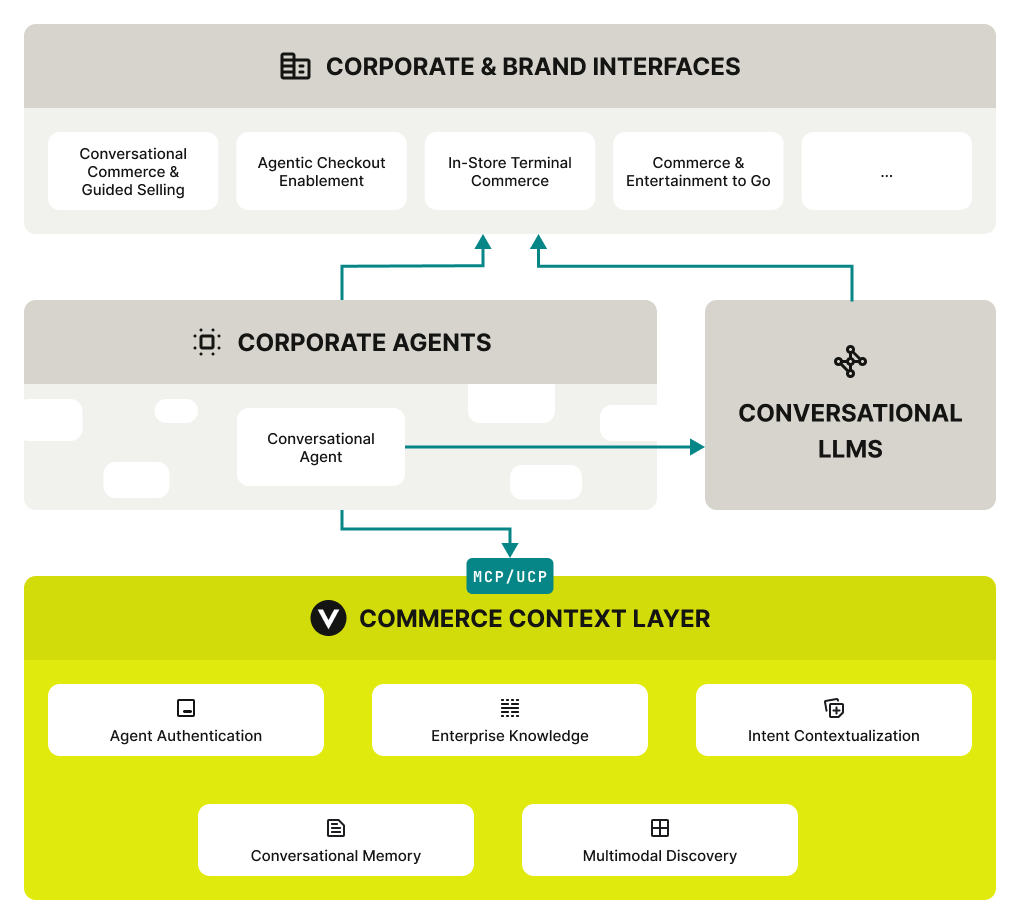
The Strategic Imperative: Own the Data & Infrastructure
When powered by a dedicated context layer, the brand experience transitions from fragmented touchpoints to a multimodal, frictionless ecosystem where the system truly understands the customer. Because the underlying architecture retains context from past interactions and deeply understands complex product relationships, the user never has to repeat themselves.
B2A optimization is not a minor technical patch; it is a board-level strategic imperative. Just as brands previously spent a generation optimizing for Google’s SEO algorithms, they must now optimize for the procurement algorithms of the conversational touchpoints.
Enterprises that invest early in making their commerce context cleanly accessible to machines will dominate the automated shortlists of tomorrow. Your user interface is no longer the only storefront; your data architecture is.
Related Posts

Meet vviinn and moin AI at dmexco 2026
