 Back to Blog
 Robotics, Retail, and the Rise of Agentic Commerce
A field note from China’s latest robotics development

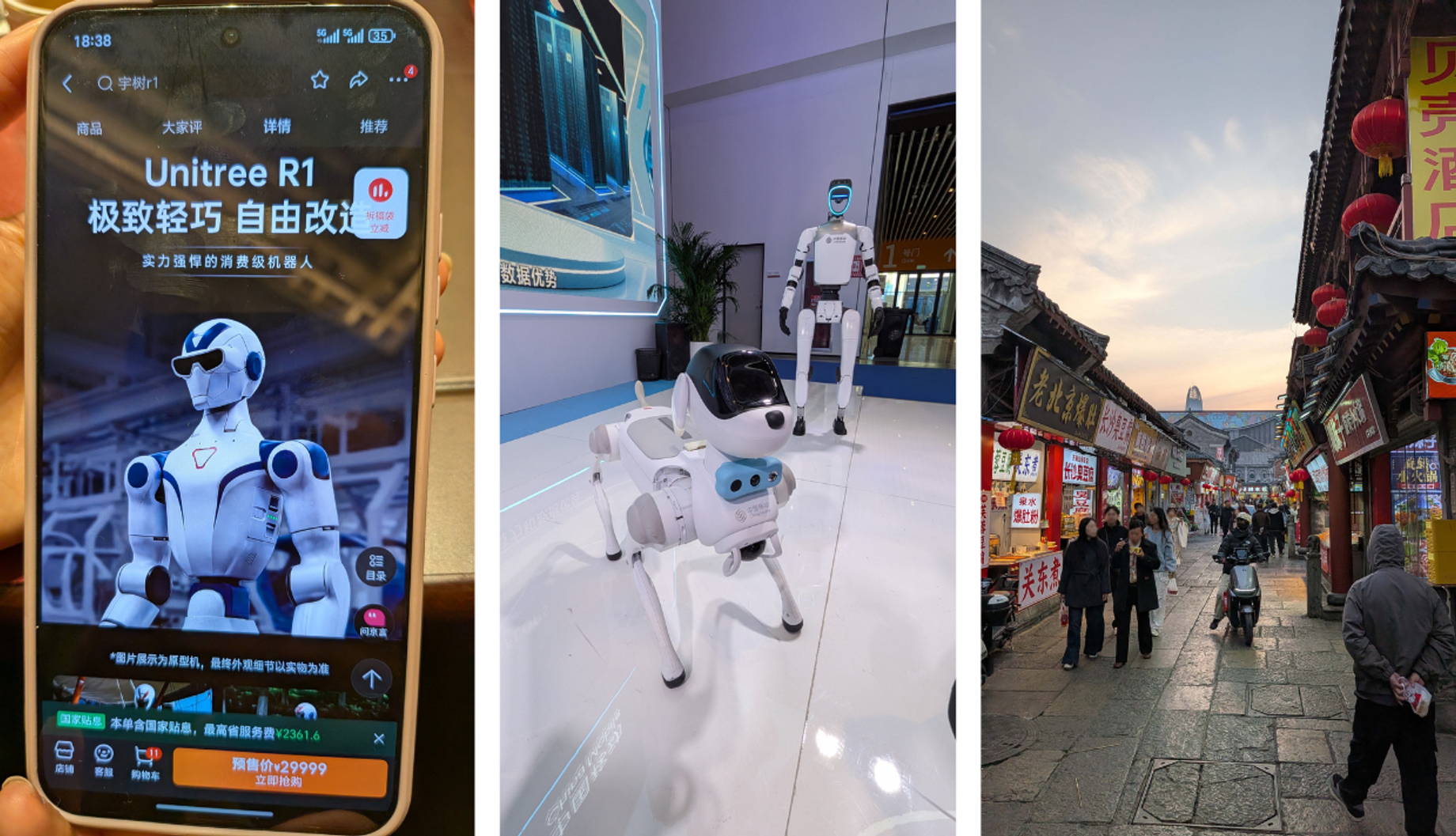
For years, commerce has been becoming more digital. Search moved online. Discovery became multimodal. Interfaces shifted from fixed navigation to intent-based interaction.
The next step is already beginning to appear: What we are seeing in robotics today is not yet the future of commerce in a finished form. But it is an early signal of where interfaces are heading: away from static systems and toward agents that can perceive, respond, and act in more embodied ways.
During a recent delegation trip to Shandong region, China, our CEO Philipp had the opportunity to see Unitree humanoid robots in a live demo and even interact with one himself. The encounter was striking not because it suggested an immediate retail use case, but because it made something tangible that is often discussed too abstractly: intelligent systems are leaving the display.
That shift matters for commerce.
From digital interfaces to agentic interaction
Today, most digital commerce is still organized around screens. Customers type, click, scroll, filter, and compare what they see. Even when AI is involved, the interaction often remains bound to a screen and a sequence of commands. Agentic systems suggest a different direction.
They do not simply display information. They interpret context, respond dynamically, and support action in a more active way. In digital commerce, this is already visible in systems that understand natural language, combine text and image inputs, and guide users toward relevant outcomes more directly than traditional search ever could.
In physical environments, the implications are broader. Robotics adds movement, spatial awareness, and real-world interaction. That does not mean stores will suddenly be filled with humanoid sales assistants.
Most of what we discuss today still stays in assistive or semi-autonomous settings, not full autonomy in open retail environments. But even at that stage, it is clear that the interface layer of commerce is expanding. We need to develop the capability that makes it possible for the assistive systems to be truly useful to future customer needs.
How this relates to commerce today
China offered a useful setting for this observation, not as an exotic contrast, but as a concrete example of how quickly technological signals can move into public visibility. Some of the robotics experiences shown around the Chinese New Year period made visible what many industries are only beginning to grasp: intelligent systems are becoming easier to see, easier to engage with, and easier to imagine in operational roles.
For European companies, this should not be read as a reason for alarm. It should be read as a prompt.
The real question is not whether robotics will instantly transform commerce. The more relevant question is which capabilities companies should build now because interfaces become more agentic over time. And that starts much earlier than robotics itself.
The infrastructure behind the interface
Before an intelligent system can act well, it needs to understand well. That means handling language, images, products, environments, and intent in a structured and reliable way. It means connecting perception with retrieval, retrieval with decision logic, and decision logic with operational systems. Here the future of commerce is already taking shape.
A customer may begin with a photo, a vague question, or a situational need. An effective system must interpret that input, connect it to product data, understand relevance, and generate a useful next step. Today, that may happen in a digital storefront. Tomorrow, similar logic may support physical retail, service environments, or robotic systems interacting with people and products in space.
The visible interface may change. The underlying requirement does not.
What companies in Europe can take from this
For retail and e-commerce leaders in Europe, the takeaway is not that every company now needs a robotics roadmap.
It is that commerce interfaces are becoming more fluid, more multimodal, and more action-oriented. The businesses best prepared for that shift will not be those chasing every visible trend. They will be those building the right foundations: structured data, multimodal understanding, and operational AI that works beyond a demo.
This is especially relevant in a market where many companies are asking a practical question: How do we move from AI curiosity to AI usefulness
Part of the answer lies in recognizing that the interface is changing again. Search boxes gave way to richer discovery. Static journeys are giving way to responsive systems. Digital commerce will remain central, but it will increasingly connect to physical environments in new ways. Robotics is one early signal of that evolution.
A glimpse of what comes next
What stayed with us from Jinan was not a single machine or a dramatic prediction. It was the sense that a broader shift is becoming easier to see. Commerce will remain digital. But it will also become more agentic. And over time, some of those agentic capabilities will move into the physical world, occupying space in a way we haven’t experienced yet.
This is why multimodal, structured, operational AI matters. Because when interfaces evolve, the strategic question is not only what the human users see. It is what your systems are able to understand, connect with, and execute behind the scenes.
That is where the next generation of commerce will be built.
Please reach out to us, if you would like to discuss the agentic shift with us. The time is now.
Related Posts

China Runs Fast. Agentic Commerce Runs on Protocols.
