
AI Commerce Reality Check: Why the <1% Stat Misses the Real Revolution
If you listen to the AI skeptics in commerce, they’ll point to a single, uncomfortable statistic: Generative AI directly drives under 1% of total retail website visits. To critics, that single digit is proof that the hype cycle has outrun reality: that AI shopping is a novelty rather than a fundamental pivot. Not quite, we say.


The real reality check isn’t whether AI commerce is happening. It’s where it’s happening.
Judging the impact of AI by direct website referrals is like judging the impact of mobile phones in 2007 by counting how many desktop websites were opened on a 3.5-inch screen. You’re measuring the wrong metric on the old grid.
Adoption already ran ahead of the Traffic
Why is direct referral traffic so low? Because consumer adoption has already leapfrogged the standard checkout line.
Recent research from McKinsey paints a striking picture: over 50% of consumers are actively using AI to prepare their purchase decisions. The behavior is already here, even if the checkout button on the AI platform isn’t (yet).
As shown in the chart, consumers aren’t waiting for a full end-to-end “buy button” inside ChatGPT or Gemini to change how they shop:
- 84% use AI tools in their everyday lives.
- 63% use AI to compare brands, prices, and reviews.
- 55% use AI to learn about product categories before making a decision.
- 46% rely on AI for product discovery and inspiration.
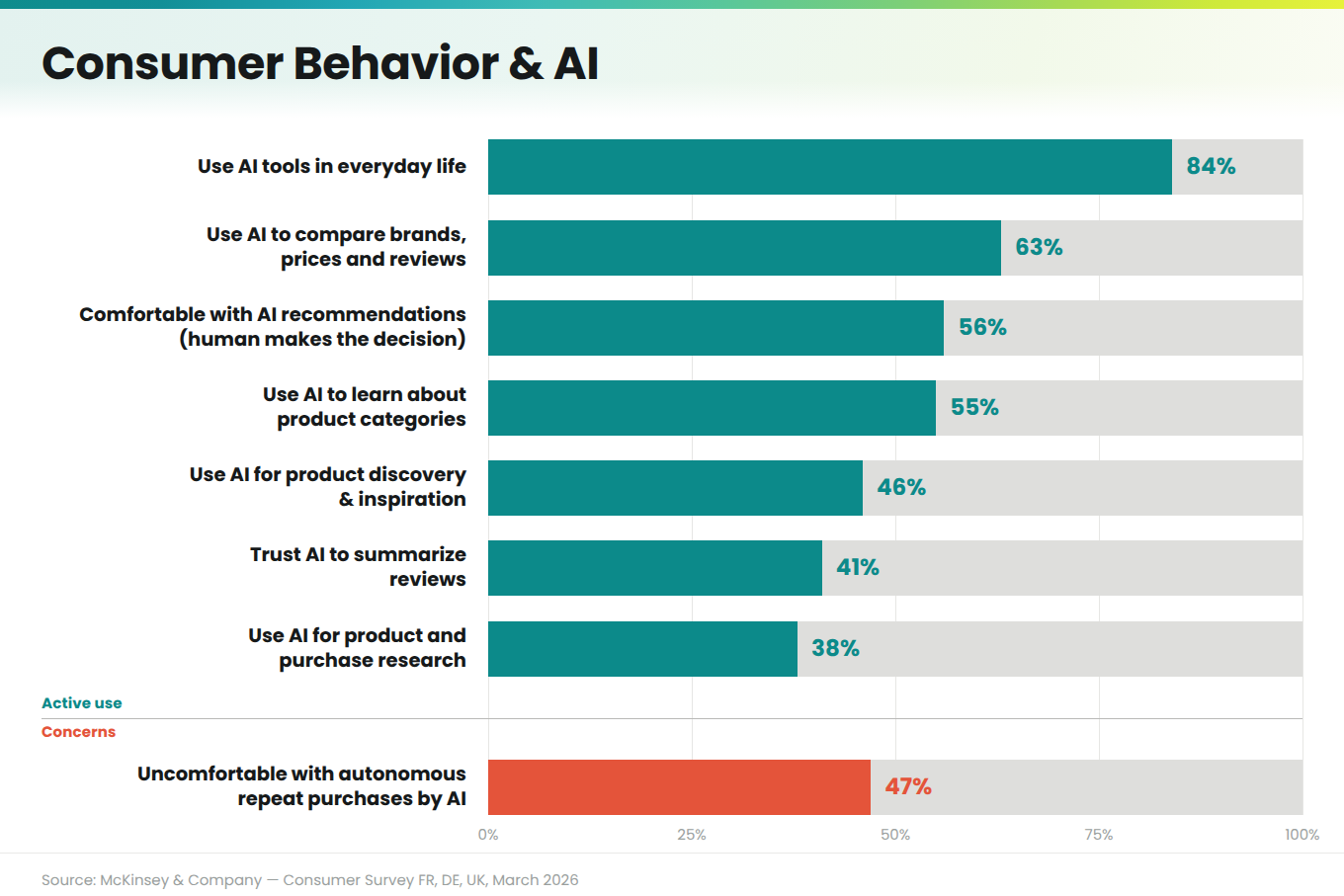
This highlights a critical divide: the research and decision layer is already mainstream, while the transaction layer is just getting started. Consumers are delegating the cognitive heavy lifting - filtering, comparing, discovering - to AI agents, only hopping over to the retailer’s site at the very last second to enter their credit card details.
That gap between decision and transaction is where the actual e-commerce revolution is brewing.
The Speed is the Telltale Sign
The shift from manual search to agentic decision-making is happening faster than any digital shift before it.
Sensor Tower data confirms that AI platforms are scaling user bases and daily engagement faster than legacy social networks or search engines ever did.
According to Bain & Company, 15% to 25% of all e-commerce revenue will flow through autonomous commerce by 2030.
The trajectory is what matters, and the capabilities of these models are escalating rapidly.
Looking at the evolution of major platforms - from ChatGPT and Gemini to Perplexity, Copilot, Meta, and Claude - we see a distinct movement across Commerce Readiness Levels:
- Level 1 (L1): Basic web search & product links
- Level 2 (L2): Rich product cards with real-time specs & pricing
- Level 3 (L3): Native buy buttons
- Level 4 (L4): In-feed shopping carts
- Level 5 (L5): Auto-buying and true autonomous agentic commerce
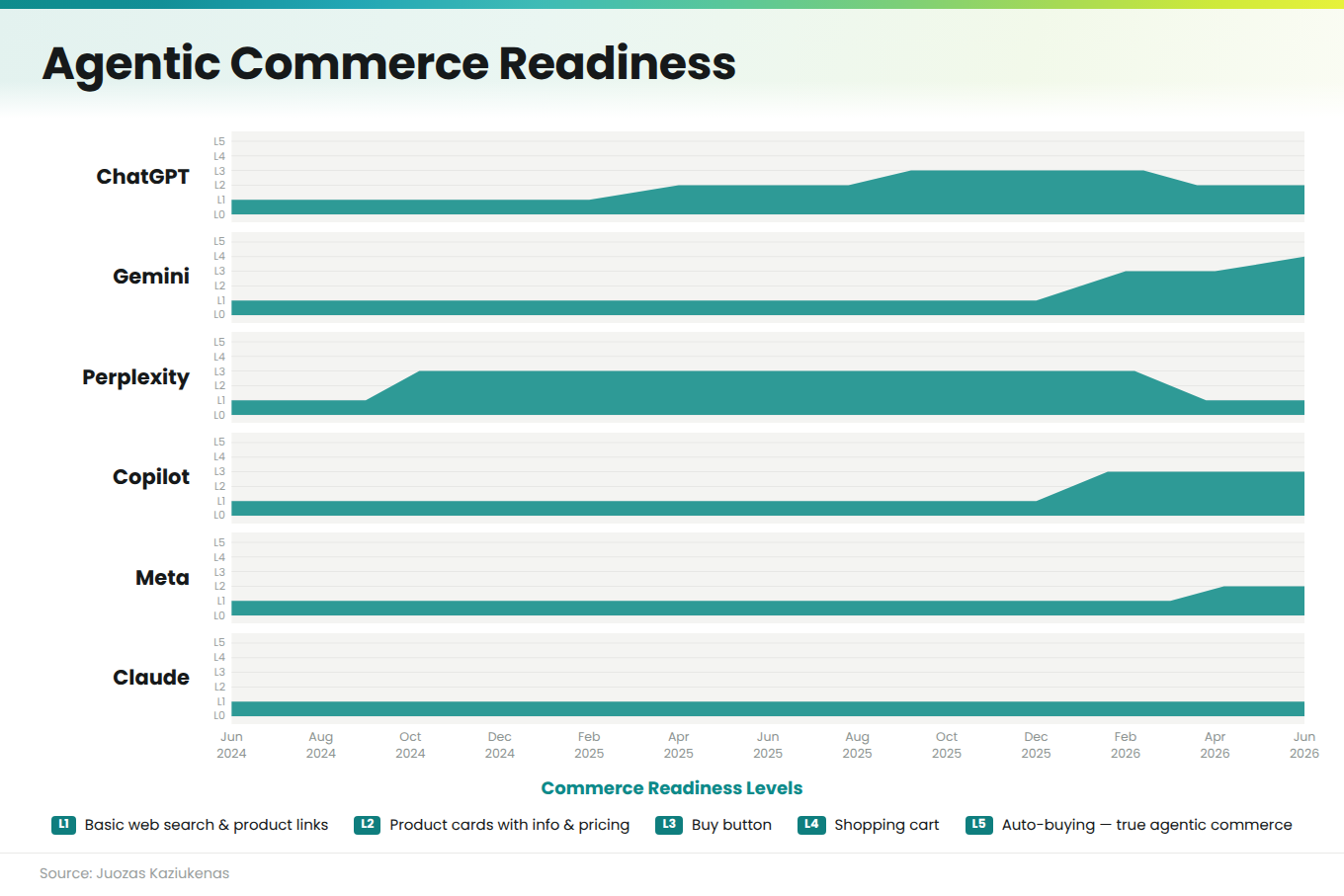
While many platforms started strictly at L1 or L2 research tools, leading LLM ecosystems are steadily unlocking L3–L5 capabilities. The rails are being laid in real time.
Why it’s invisible: agents need new rails
If consumer behavior is moving this fast, why does agentic commerce still feel invisible on standard dashboards?
Because today’s web was built for human eyes, not artificial agents. The web runs on visual layouts, pop-ups, banners, and manual form fields.
For an AI agent to search, evaluate, negotiate, and execute a purchase seamlessly, it requires an entirely new set of tracks and interfaces.
According to McKinsey, retail is moving through three distinct waves of adoption on the path to autonomous commerce:
Wave 1: Generative Engine Optimization (GEO) Companies shape their brand and product presence so AI platforms understand and recommend them during the discovery phase.
Wave 2: AI-Orchestrated Commerce AI tools embedded directly into retail platforms create brand-owned, dynamic, individual interfaces for searching, selecting, buying, and receiving products.
Wave 3: Autonomous Commerce AI agents complete purchases entirely on their own with zero real-time customer involvement (starting with routine household goods and subscription replenishment).
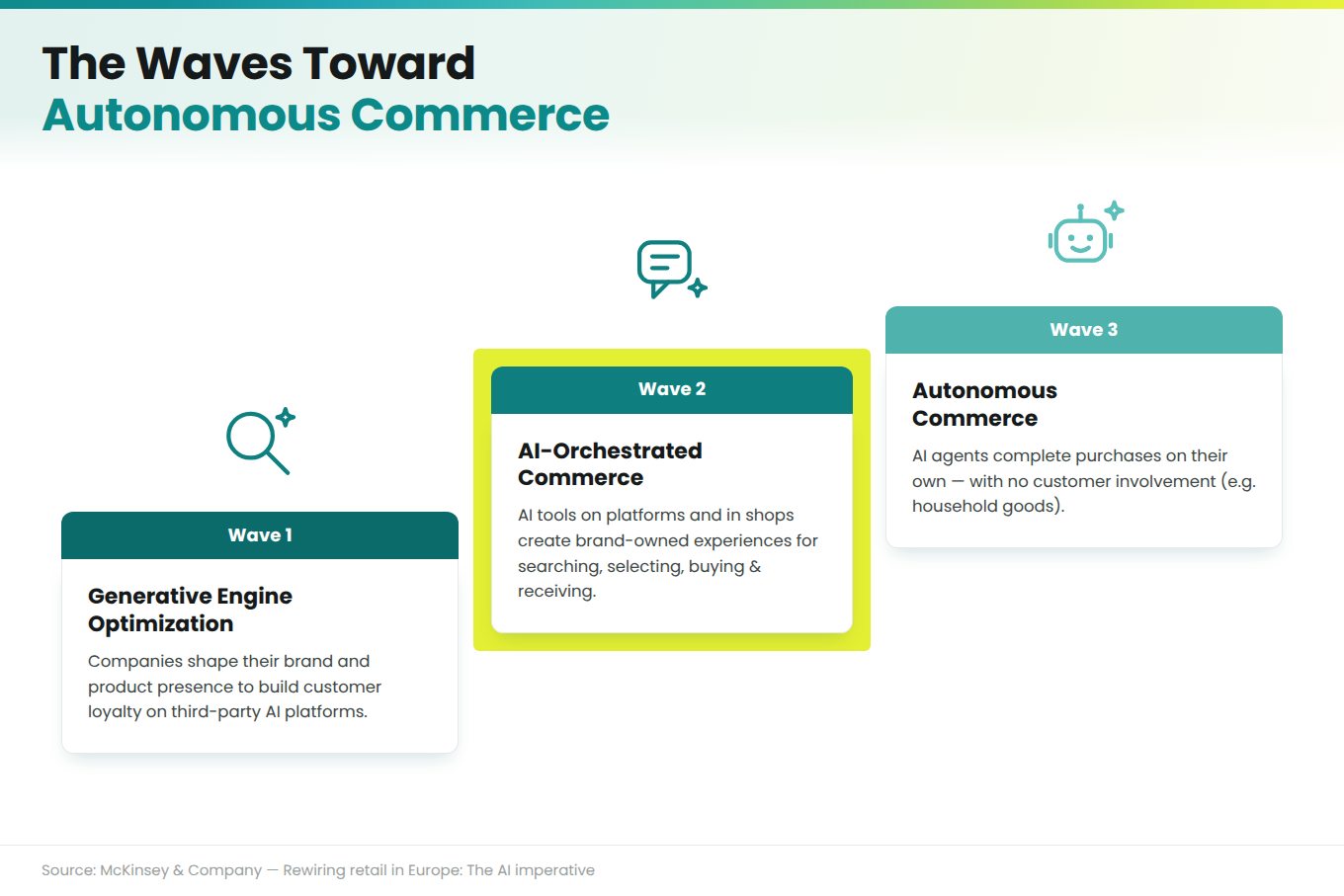
The key takeaway: This is a fundamental infrastructure shift. And infrastructure is always invisible right up until the moment it is everywhere!
Our thesis at vviinn: Channels Need to Get Ready for the Brand-to-Agent (B2A) Era
For decades, e-commerce relied on visual triggers: high-resolution images, persuasive copy, and a frictionless layout. But we are now entering the Brand-to-Agent (B2A) era.
When an AI agent queries your catalog, it doesn’t care about your button colors or font sizes. It relies entirely on cleanly structured, hyper-accurate, and instantly verifiable data. If your product information cannot support an LLM-driven system in milliseconds without hallucinating, your brand becomes functionally invisible to the AI.
Get your infrastructure ready and provide the UX people get used to in their AI Chatbots. vviinn helps brands to give agents access to their inventory, driving the fundamental shift from visual storefronts to machine-readable ecosystems.
This is a structural imperative. Brands must move beyond optimizing generic LLMs and build a dedicated Commerce Context Layer (CL).
This layer acts as a semantic translator, ensuring that whether a customer is using a conversational kiosk in-store or an autonomous agent is trying to execute a checkout, the underlying data architecture understands the context perfectly.
Your UI is no longer the only storefront; your data architecture is what determines if you make the cut.
The Real Reality Check
So let’s reframe that uncomfortable opening number: “under 1% of retail traffic comes from GenAI.”
Under 1% does not translate to “not yet.” It translates to the visible tip of an enormous iceberg.
The actual adoption has already taken place in the research and evaluation phases.
Consumers are already letting AI narrow down choices, compare specifications, and curate their world. What remains invisible today is the structural work taking place beneath the surface. The protocols, APIs, and agentic rails being laid down to handle the eventual transaction.
When those tracks fully connect, the jump from 1% to 20% won’t be a slow climb; it will be an overnight shift.
The build is happening right now in the layers nobody sees. And the brands preparing their infrastructure today are the ones that will win the agent-led economy tomorrow.
Related Posts

China Runs Fast. Agentic Commerce Runs on Protocols.
