
vviinn Outperforms the Field in Precision Visual Search - Built for Commerce Context
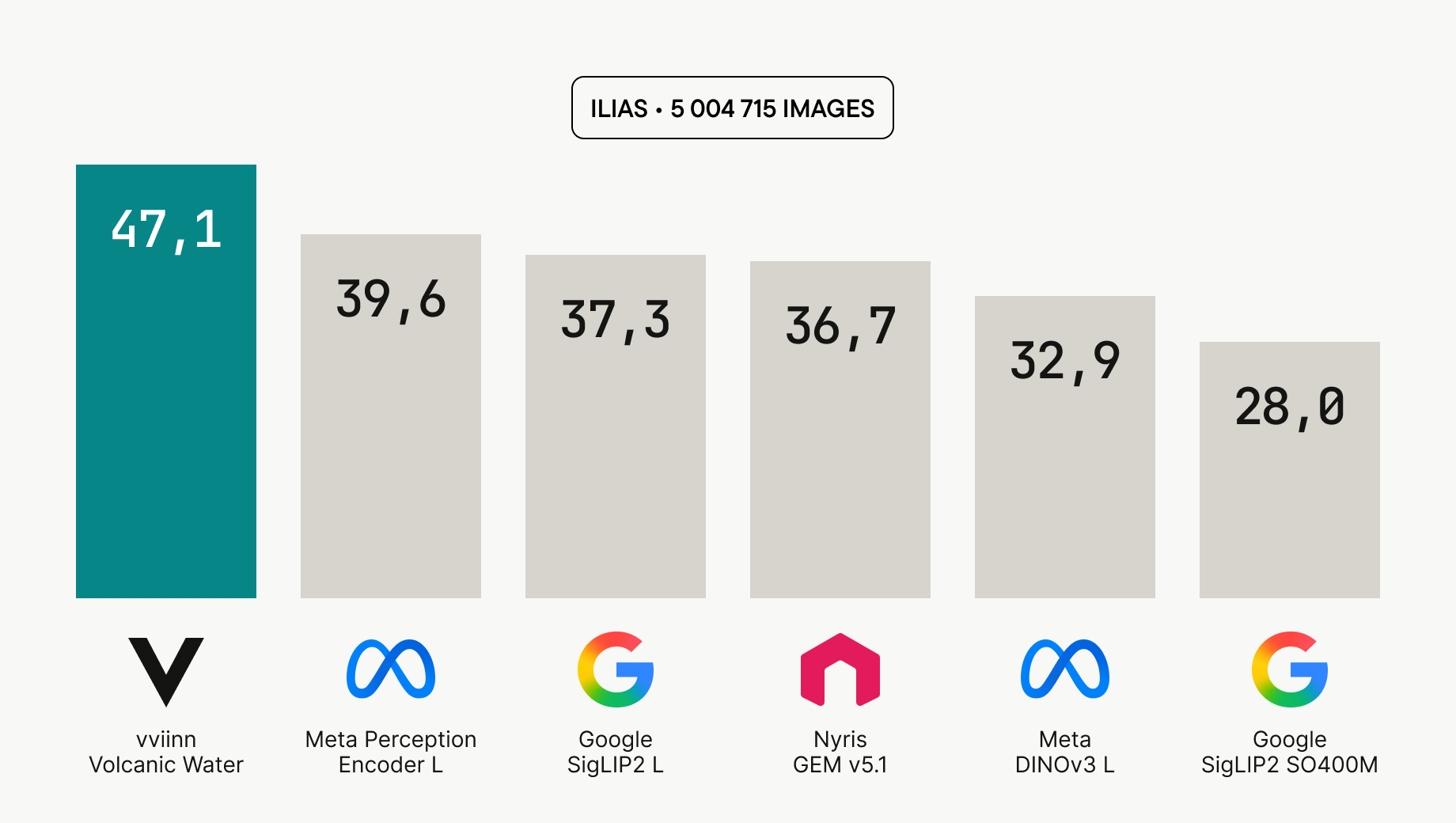
ILIAS is one of the hardest public benchmarks for visual search: find one specific object among five million photographs. Volcanic Water, the model running vviinn visual search today, scores 47.1 searching with a photo and 33.8 searching with a text description, ahead of every result on the official leaderboard, including the large general purpose models. This post presents the results and explains exactly how we measured them.

Searching a product catalog really comes down to two halves. First, there’s the product metadata, the title, description, color, material, and category, most of which is written by hand. Then, there’s what the item actually looks like.
Handwritten metadata is thin exactly where it matters most. Color is the clearest case. A sofa gets entered as “gray”, and that one word has to carry a warm gray, a cool gray, a gray with a green cast, a gray that photographs as beige. The picture knows the difference. The word does not.
Most search engines index the first half and leave the second largely unused. The text is searched; the images are stored and served to the browser, and at best a model reads each picture once and produces a handful of tags, which end up in the text index too.
At vviinn the second half is an index of its own, built from the product images themselves, and a query reaches it either as a photograph or as a sentence. This post is about that index, and about how the model behind it performs on a public benchmark.
The benchmark
ILIAS was published at CVPR 2025 by a group at the Czech Technical University in Prague. It asks a narrower question than most retrieval benchmarks: not “find me a sneaker” but “find me this sneaker”. A thousand specific objects, 1,232 photographs and 1,000 written descriptions to search with, 4,715 correct answers, and five million unrelated photographs to hide them in. The objects are browsable, and worth a minute of your time if you want a feel for how specific they are.
That narrowness is the point for product search. Someone photographing a lamp does not want a lamp like it. They want that lamp, in the right finish, in stock. And five million is the first public benchmark at a scale where the hard part stops being recognition and starts being distraction, which is what a real catalog does to a search engine.
The score is mean average precision: how near the top of the results the correct answers land, averaged over every query.
It is also a clean test. Nearly all of the query and reference photographs were taken by the benchmark’s own collectors, of objects checked not to have existed publicly before 2014, and they were first released in 2025. ILIAS is not among our training sources, and it played no part in choosing the model.
Results
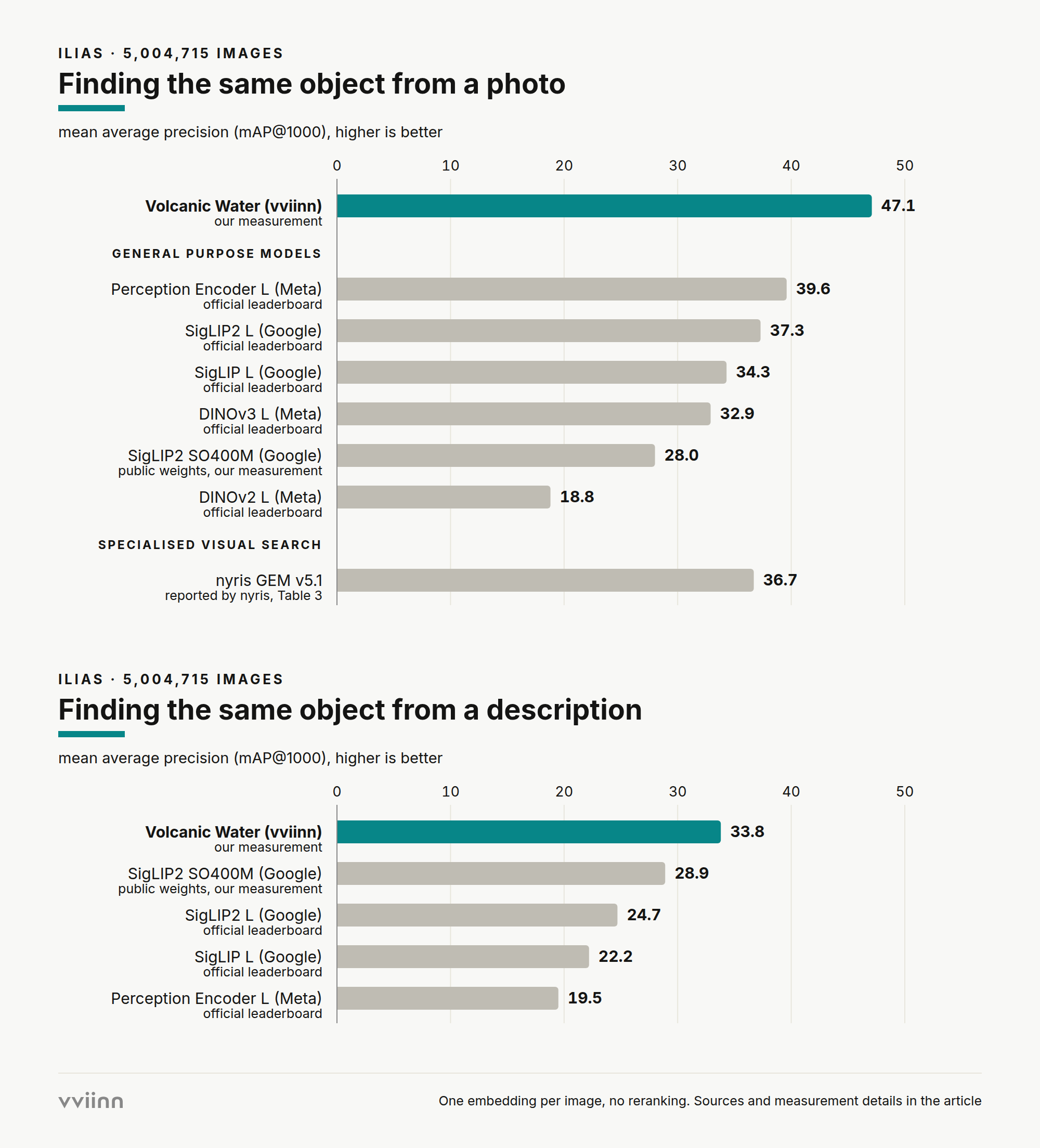
Volcanic Water, the model serving vviinn search today, scores 47.1 searching with a photograph and 33.8 searching with a written description. The same model does both. Two comparisons put those numbers in context.
Against the large general purpose models
The official leaderboard lists the image models of Meta and Google: Perception Encoder, DINOv3, SigLIP and SigLIP2. The best result on it for any of them is 39.6 with a photograph and 24.7 with a description. These are excellent models, and they are built to do many things well. Volcanic Water is trained for one of those things, recognising the same object again, and on that task it is ahead.
Among specialised visual search providers
Few companies in visual search publish results on an independent benchmark. nyris is the exception: it reports 36.7 on ILIAS for its GEM v5.1 model, in the range of the best general purpose models. We think publishing such numbers is the right practice, and we are glad not to be the only ones doing it. On the same benchmark Volcanic Water is about ten points higher.
Every number in the chart is a single global embedding: one vector per image, produced by one forward pass. That is the setting a catalog of millions can carry, and it is the one we report in. GPR1200, a smaller public benchmark covering six very different domains, shows the same picture: 88.9 against 76.1 for the strongest public model we measured.
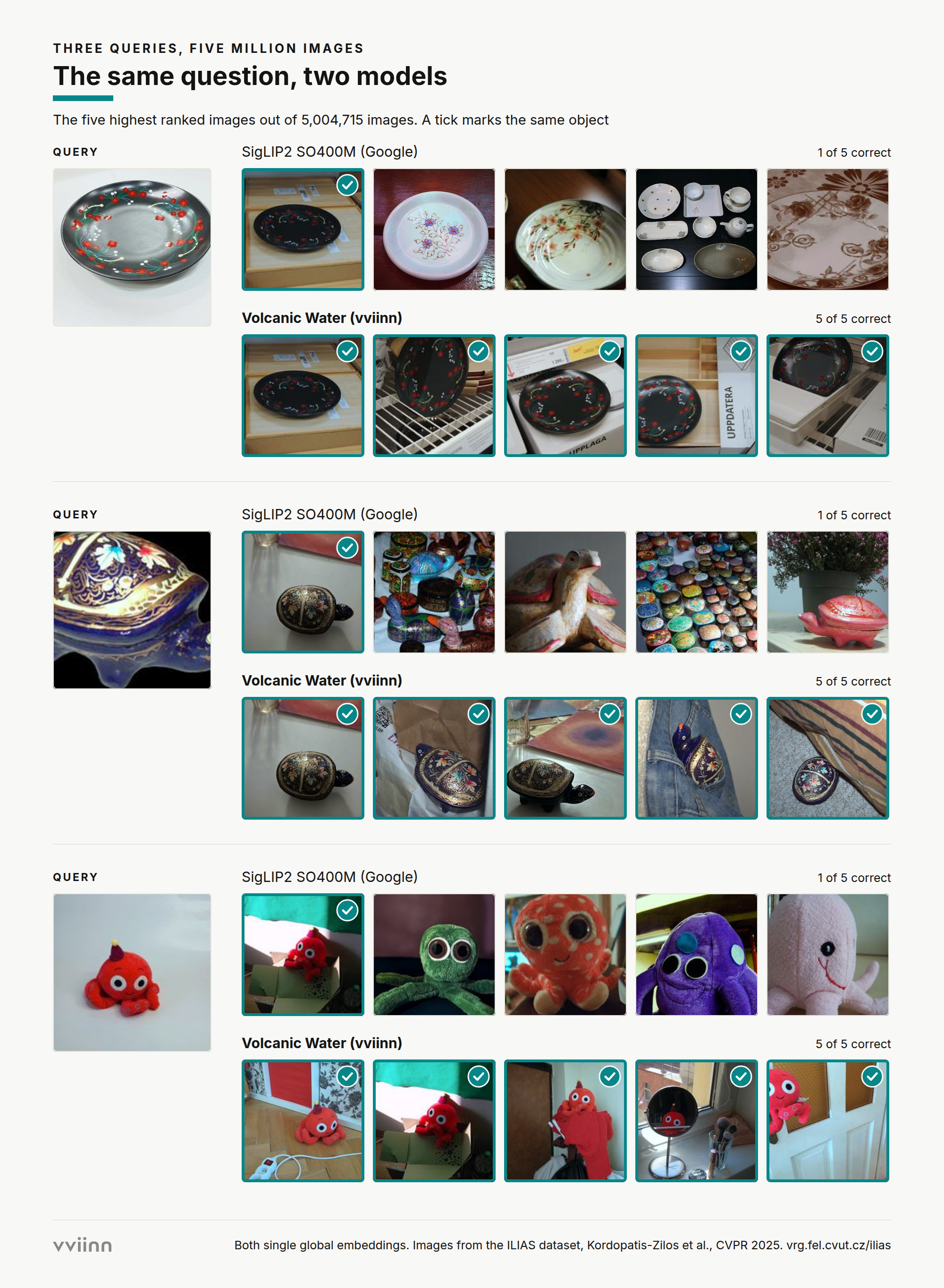
Numbers are abstract, so here are three queries: a painted plate, a small lacquered turtle, a red felt octopus. SigLIP2 answers the question “what is this a picture of” and returns other plates, other painted trinkets, other octopus toys in green and purple and pink. Reasonable answers, but not what a shopper asked for. Volcanic Water returns that plate, that turtle, that octopus, photographed on a shelf, on a pair of jeans, on a windowsill. That is the difference between matching the subject and matching the object.
How we measured
A benchmark number is worth as much as the way it was obtained, so here is ours in full.
Data. The official mini ILIAS set as distributed by its authors: all 1,232 image queries, all 1,000 text queries and the complete database of 5,004,715 images. Nothing was sampled or filtered.
Metric. mAP@1000, the metric of the leaderboard.
Model. One embedding per image and one per query. No reranking, no query expansion, no second stage, and no part of the model was trained or adapted on ILIAS.
Input. Our own measurements, Volcanic Water and SigLIP2 SO400M, use a 384 pixel center crop, which is what runs in production. The leaderboard tests each model at its own input resolution.
Check. Before measuring our own model we ran a leaderboard model, SigLIP B at 256 pixels, through our pipeline. We obtain 14.6, 10.3 and 20.6 in the three leaderboard tables. The leaderboard lists 14.6, 10.3 and 20.6.
Comparison numbers. Leaderboard values were read from the official ILIAS page in November 2026 and are the best listed for each model. For image search, that is the table in which a linear layer is trained on top of the otherwise unchanged model; used exactly as released, the best listed result is 31.1. The leaderboard has no category for fully trained models such as ours. The nyris value is the mAP@1000 figure from Table 3 of their paper; the model is not public, so we could not measure it ourselves. Approaches that store several vectors per image, or rerank a shortlist, can score higher at several times the index cost. They are outside this comparison.
Where this comes from
The method behind Volcanic Water is public: the MCIP work, with code, weights and paper all out in the open. What the model adds is a newer backbone and a lot of training on real product data, and why that training is necessary at all is an argument I made at more length earlier this year.
What’s next
Volcanic Water is what runs today. Our current research model reaches around 51 searches with a photograph, on the same benchmark, the same five million images and the same measurement as the 47.1 above. More on that once it is in production.
Related Posts

Cheaper Index Construction: Two Bits per Dimension
